
EQRC was founded with a strong focus on Quantitative Analytics, particularly quantitative finance and financial engineering. Our expertise has traditionally centred on front-office challenges across both the buy side and sell side, making this field our core specialisation and enduring passion. Download our implied volatility consultancy 1 pager rational or our option systematic strategy.

Today, the majority of EQRC’s activities remain focused on quantitative finance, with a longstanding specialisation in implied volatility surface modelling. Our proprietary models have been deployed across several leading trading desks and applied to most major asset classes, including equities, commodities, foreign exchange, interest rates and cryptocurrencies.
Our work combines direct industry applications with postgraduate-level education, enabling us to maintain both practical relevance and academic rigour. We aim to operate at the frontier of applied quantitative finance while continuing to explore more ambitious, blue-sky research questions.
We also periodically publish research papers in areas where we have established academic expertise, particularly when we believe that the resulting insights can support practical applications in quantitative finance. For a broader overview of our previous work, please visit our download page, where we share a selection of research materials and publications.
The symbolism behind the flying eagle depicted on the left is twofold. First, the adult bald eagle is commonly regarded as an apex predator, occupying the highest level of its food chain and exerting a defining influence over the ecological system in which it operates. Second, the distinctive shape and span of its wings give the eagle exceptional agility, precision and grace, allowing it to navigate the sky with remarkable control.
A similar analogy can be drawn with vanilla options and, more specifically, the implied volatility surface. Since the introduction of the Black-Scholes framework, these concepts have played a central role in shaping the landscape of modern finance. The implied volatility surface can assume a wide range of forms, and this flexibility allows practitioners to price and manage complex derivatives with a degree of precision that would otherwise be extremely difficult to achieve. Much like the eagle’s wings provide the agility required to master its environment, the implied volatility surface provides the mathematical flexibility required to navigate the complexity of financial markets.
“Beauty is the first test: there is no permanent place in the world for ugly mathematics.”
-G. H. Hardy

Every successful quantitative project begins with a clear definition of the problem. We work closely with clients to identify the underlying objective, distinguish essential requirements from secondary considerations, and translate business questions into well-defined quantitative problems.

Every model is valid only within a specific set of assumptions. We make these assumptions explicit, assess their limitations, and examine the consequences when they fail to hold. This discipline often leads us to consider several solutions, each offering a different balance between robustness, accuracy and complexity.

We develop models that combine established quantitative methods with original research. Our objective is not maximise the benefits to complexity ratio, carefully balancing sophistication, empirical performance, interpretability and practical usefulness, while always keeping track of the model limitations.

A model creates value only when it can be implemented reliably. We therefore place considerable emphasis on computational efficiency, system integration, maintainability and the successful deployment of quantitative solutions within the client’s operational environment.
Whether in investment banks, hedge funds or clearing houses, portfolio-level risk management has become an important area of research for quantitative practitioners. In the context of options risk modelling, a central challenge is to construct a volatility surface that remains compatible with a broad range of pricing models. In practice, most pricing systems are designed to reject volatility surfaces that admit arbitrage opportunities. This requirement is particularly important in clearing, where the scenarios used to calculate initial margin must remain internally coherent. A stressed volatility surface containing arbitrage would violate this condition. Addressing the problem therefore requires a methodology capable of performing two tasks: first, determining whether a volatility surface is arbitrage-free; and second, adjusting the surface when necessary to remove arbitrage opportunities. These procedures were introduced in our earlier work (download) and applied across equity, commodity and foreign exchange markets. The same paper also introduced the gSVI parametrisation, which provides a geometric representation of volatility surfaces across these asset classes. However, its de-arbitraging framework remains incomplete when applied to foreign exchange markets because it does not fully incorporate the triangle rule, a constraint specific to FX. The objective of the IVP project (download) is to extend the original methodology so that it also satisfies the constraints imposed by the triangle rule. The project further introduces an original liquidity model that improves the parametrisation while allowing the de-arbitraging procedure to be applied with greater flexibility.
Quantitative finance contains results that are mathematically elegant, widely cited and nevertheless easy to misinterpret or apply beyond their valid scope. A notable example arises in SVI volatility modelling, where a widely used slope condition was sometimes treated as sufficient to guarantee the absence of butterfly arbitrage, although it is only necessary.
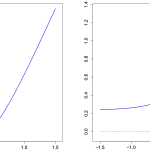
The Axel Vogt counterexample. The SVI volatility smile on the left satisfies the slope constraint b(1+∣ρ∣)≤4/T. However, the corresponding implied risk-neutral density on the right becomes negative over part of the strike range, revealing the presence of butterfly arbitrage. Passing the analytical condition is therefore not sufficient to establish that the surface is arbitrage-free. This example illustrates an important principle behind EQRC’s work. Mathematical sophistication does not, by itself, guarantee that a model or theoretical result is correct, complete or useful in practice. We examine the assumptions behind established results, verify them against first principles and test whether their conclusions remain valid numerically and economically. Readers interested in the complete derivation, the original condition and the Axel Vogt counterexample are invited to consult pages 89 to 93 of Babak Mahdavi-Damghani’s doctoral thesis.
Our objective is not to introduce complexity for its own sake. It is to determine which elements of a methodology provide genuine benefits in terms of accuracy, robustness and implementation, and which merely add mathematical sophistication without improving the final solution. This allows us to identify models that are both theoretically sound and proportionate to the problem being addressed.
“Introducing the Implied Volatility Surface Parametrization (IVP): Application to the FX Market”.
download
“the non misleading value of inferred correlation, an introduction to the cointelation model”.
download
“De-arbitraging With a Weak Smile: Application to Skew Risk”.
download