

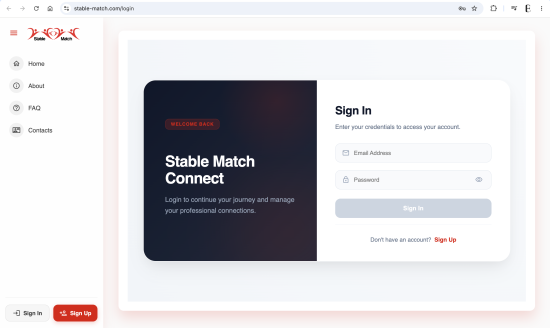
If you believe AI is merely a bubble, or irrelevant to humanity’s deepest and most fundamental challenges, prepare to reconsider. When cutting-edge AI meets Nobel Prize-winning economic theory and one of humanity’s most important goals after survival, the world does not simply change, it is transformed for ever. The real question is who will recognise that opportunity early enough to help shape it and benefit from its growth. If you are an investor and are interested in what we are doing, feel free to contact us or view our Stable-Match presentation to discover the investment opportunity. Additionally, you can visit our minimum viable product here. You can watch conceptually what the MVP does in the below video which was our first beta under the name of Oolalaaa or watch our latest interview.
Game-theoretic AI represents a major untapped business opportunity and lies at the heart of what we call Cognizant Social Engineering, the concept represented by the “C” in EQRC. Its purpose is to design intelligent systems that improve how individuals, businesses and institutions are matched with one another. Matching theory has already demonstrated its value in highly structured environments, including the allocation of medical graduates to hospitals and students to schools. The research associated with these mechanisms contributed to Nobel Prize-winning work in economics. Yet dating remains one of the largest and least effectively designed matching markets. Most dating platforms rely on superficial filters, individual recommendations and repeated swiping. They attempt to predict whom a user may like, but rarely consider the preferences, alternatives and strategic choices of all participants at the same time. This creates inefficient matches, excessive competition for the same profiles, hidden incompatibilities and a poor user experience. By combining artificial intelligence with stable-matching mechanisms, dating platforms can move beyond simple recommendation engines. They can learn complex preferences, account for mutual compatibility and identify the best realistically achievable match for each user within the wider network. The same principles can also be applied to recruitment, lending, procurement, advertising, logistics and digital marketplaces. Rather than merely predicting individual behaviour, Cognizant Social Engineering seeks to optimise interactions across entire systems, producing outcomes that are more efficient, stable and valuable for everyone involved.




Marketing Strategy and Campaign
Although the project has not yet been formally marketed, we have already invested considerable time in developing the conceptual foundations of the campaign. Several elements of the proposed growth strategy are presented in the Stable Match business presentation. At its core, the campaign would use humour to make the product memorable, accessible and highly shareable. One possible positioning line is: “Stable Match: aim high, but remain realistic.” This captures the platform’s underlying promise in a simple and playful way. One example of how this concept could be translated into video content is presented alongside this section. Alternative campaign ideas could rely on more unexpected forms of humour, using surprising scenarios (e.g. this video) to attract attention and encourage organic sharing across social media.
A Brief History of the Project (1st Beta: “Oolalaaa”)
The project’s first beta version was launched under the name “Oolalaaa.” The choice of name had both a personal and a commercial origin. On a personal level, “Oolala” began as an inside joke among a group of friends. From a branding perspective, the name was also influenced by the perceived popularity among venture capital investors of technology companies with double letters or repeated vowels, such as Google, Yahoo, Zoopla and Zoosk. In retrospect, the name proved to be a poor strategic choice. “Oolala” was already in use, which required us to add three additional letters to secure a distinctive name and domain. This made the brand more difficult to pronounce, remember and position. The situation became more problematic when an unrelated and inappropriate website began operating under a similar name, creating an unacceptable risk of confusion and reputational damage.
More about the Project History (2nd Beta: “Stable-Match”)
The original project was entirely financed from the founder’s personal income, which imposed strict limitations on the development budget. To control costs, a group of freelance engineers based in India was initially hired. Unfortunately, the development process was poorly coordinated, and previously resolved bugs were repeatedly reintroduced into the platform. As a result, the product never reached the level of technical stability required for a successful public launch. Several smaller venture capital firms approached the project during this period. However, the proposed investments and valuations were not sufficient to finance the redevelopment needed to give Oolalaaa a realistic chance of success. Rather than accepting external capital for a product that had lost momentum and still faced significant technical challenges, we decided to pause the project and focus on rebuilding its foundations.
The concept was revived in 2026 under the new name Stable Match. This time, the project was developed through a smaller and more tightly structured team, with key responsibilities assigned to trusted collaborators whose incentives were directly aligned with the long-term success of the business. The first web-based Minimum Viable Product was released to a limited test group in July 2026. Native applications for Apple iOS and Android are currently under development. The platform is initially being tested within a limited circle of users, allowing us to gather feedback, identify technical issues and refine the user experience before a broader launch. We expect to begin considering external investments soon. Any investment would be used to strengthen the engineering team, accelerate mobile development, support user acquisition and prepare the platform for wider commercial deployment.